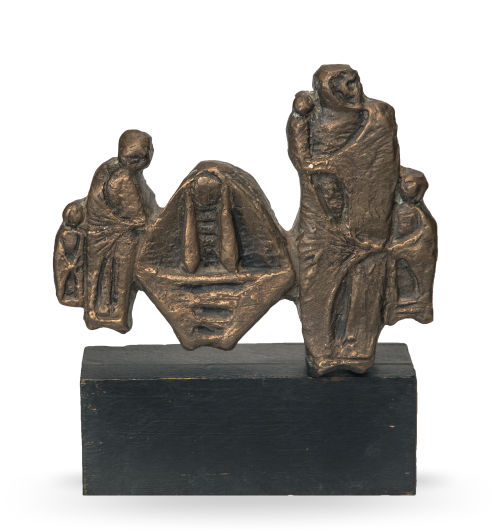
April 20, 1929 Artist Mohammed Ghani Hikmat was born in in the capital, Baghdad, Iraq. His father was a tailor for men's abayas in the Kadhimiya market.
1943 - 1950 He studied primary school at Al-Kadhimiya Al-Amiriya School and middle school at Al-Kadhimiya School for Boys, and secondary school at Al-Adhamiya School for Boys.
1949 / 1950 - 1953 He studied sculpture in the evening department at the Institute of Fine Art - Baghdad. He participated in the meeting of the General Assembly of the Friends of Art Association, which was held at the home of Mrs. Nahida Al-Haidari.
1952 He participated in the Ibn Sina Festival in Baghdad and exhibited sculptural works made of gypsum, wood and alabaster.
1953 He worked as a teacher at the Institute of Fine Arts in Baghdad and joined the Baghdad Group for Modern Art and participated in its second exhibition, in which he exhibited 6 works of wood and gypsum.
1954 He participated in the third exhibition of the Baghdad Group for Modern Art, exhibiting 10 works of gypsum, wood, and alabaster, and participated in the first conference of Arab writers in Damascus, Syria. He began working as a teacher in the secondary schools.
1955 He participated in the Iraqi Art Exhibition in India and exhibited 4 works of wood, and he traveled to Rome to start his studies there at the Zaka Institute for Medals. He rented a small studio for him to continue sculpting, and he was accepted into the Official Ceramics School in Rome and the Academy of Fine Arts, Department of Sculpture.
1956 He graduated from the Zaka Institute for Medals.
1958 He held a solo exhibition in Rome, in which he exhibited 30 works of bronze and wood and won an award from the Mayor of Rome. He held another solo exhibition in Palermo, in which 23 colored ceramic works were exhibited.
1959 He graduated from the Academy of Fine Arts in Rome from the Department of Sculpture, won an award from the World Exhibition in Rome. Then, he became an assistant to the artist Jewad Selim in the Freedom Monument project as he was pouring bronze pieces in the city of Pistoia in the province of Florence in Italy. He held two solo exhibitions on Mericia Hall in Rome, in which 20 wood works were exhibited, and the Paris Hall in San Remo, in which 20 wood and bronze works were exhibited.
1960 He was asked to work on purchasing a bronze casting factory in Italy by the Dean of the Institute of Fine Arts, the artist Khaled Al-Jadir.
1961 He completed his studies in bronze casting in Pistoia for the 14th of July monument with Jewad Selim in the Tuscany region in Italy. Then, he returned to Baghdad and lived in his father's house in Kadhimiya and he continued the completion of the Freedom Monument in Tahrir Square after the death of Jewad Selim.
1962 He worked as a teacher of sculpture at the Academy of Fine Arts in Baghdad until 1996 and he held two solo exhibitions, one of them in Dr. Makiya’s house, in which he exhibited 40 works of bronze and wood that he made in Rome and the second in the ‘Orosdi Back’ hall in Baghdad and exhibited 45 works of bronze, gypsum and wood. He bought a plot of 200 square meters and built a workshop and smelter in Al-Dawoodi neighborhood.
1964 He won the Gulbenkian Prize as the best Iraqi sculptor.
1965 He held a solo exhibition at Al-Wasiti Hall in Baghdad, in which 42 works made of wood, bronze and copper were exhibited.
1967 He was appointed as a lecturer in the College of Engineering in the Architectural Department and worked there for five years and traveled to Italy to choose a specific marble to make a mural in the Medical City in Baghdad.
1968 He held a solo exhibition in Gallery One in Beirut, in which he exhibited 22 works of wood, bronze and copper. At the beginning of the year, he married Mrs. Ghaya Mahdi Al-Rahhal, sister of artist Khaled Al-Rahhal, and they gave birth to their eldest son "Yasser".
1970 He held a solo exhibition for only one work entitled "Baghdadi Caféالكهوة البغدادية" at a length of 6 meters in the Iraqi Artists Association in Baghdad and became a member of the National Committee for Plastic Arts and among the committee were Faik Hassan, Shaker Hassan Al Said, Hafidh Al-Droubi, Nori Al-Rawi, Jamil Hamoudi and Salem Al-Alousi.
1971 He had a girl named "Hajer". He was assigned to organize a hall for the works of the artist, Jewad Selim, to publish a book about him and make a statue of him.
1972 He participated in the Contemporary Iraqi Art Exhibition at the Hall of the National Museum of Modern Art in Baghdad.
1973 He participated in the second exhibition of the One Dimension Group in Baghdad and the fifteenth exhibition of the Fine Artists Association at the Assembly Hall and an exhibition of 14 sculptors entitled "The Persons" in the National Museum of Modern Art - Gulbenkian Hall.
1974 He participated in the cultural festival of Al-Thawra newspaper in Baghdad and the first anniversary of the ruling party exhibition at the Academy of Arts Hall.
1975 He participated in the second anniversary of the ruling party exhibition at the Iraqi Museum of Modern Art in Baghdad.
1976 He held a solo exhibition at Al-Riwaq Hall in Baghdad, in which 100 works of bronze were exhibited and he co-wrote educational books on paintings and sculptures with artists Saad Al-Tai and Amin Abbas, as requested by the Ministry of Education.
1977 He headed the sculpture department at the Academy of Fine Arts in Baghdad.
1980 He held a solo exhibition at Al-Riwaq Hall in Baghdad.
1981 He held a solo exhibition in the Hall of the Cultural Center in London, in which he displayed 85 works of bronze, and participated in the Contemporary Iraqi Sculpture Exhibition at the Venice Palace Hall in Italy.
1983 He gave, The Museum of the Twentieth Revolution, in the city of Kufa four relief carvings as a gift.
1984 He held a solo exhibition at Al-Orfali Hall, in which 100 bronze works were exhibited.
1987 He was assigned to supervise the implementation of the "Victory Arc" by the Minister of Housing.
1991 He held a solo exhibition of sculpture at the Hall of the Cultural Center in Amman, exhibiting 26 works of wood and bronze.
1993 The National Museum of Art in Baghdad allocated a permanent special wing for his works and displayed 150 statues of bronze, wood, stone and gypsum. However, after the occupation of 2003, the museum’s holdings were stolen and destroyed.
1994 He was given an award by the Minister of Culture in Lebanon.
2001 He moved his residence to Amman, Jordan but kept visiting Baghdad frequently.
2002 He headed the National Arts Committee for UNESCO in Paris and won an honorary award from the Arab League in Egypt.
2010 He won an Honorary Award for Arab Creativity in Qatar for his achievements throughout his life.
12 September 2011 The artist passed away in Amman at the age of eighty-two in Amman. His body was transported to Baghdad and buried in Al-Karkh cemetery.
2016 Google Arabia dedicated its home page to the late sculptor to celebrate his birthday.
He held and participated in many art exhibitions inside and outside Iraq.
He was a member of the Art Friends Association.
He was a member of the Baghdad Group for Modern Art.